

Turning your legacy workhorses into
Agentic Rockstars
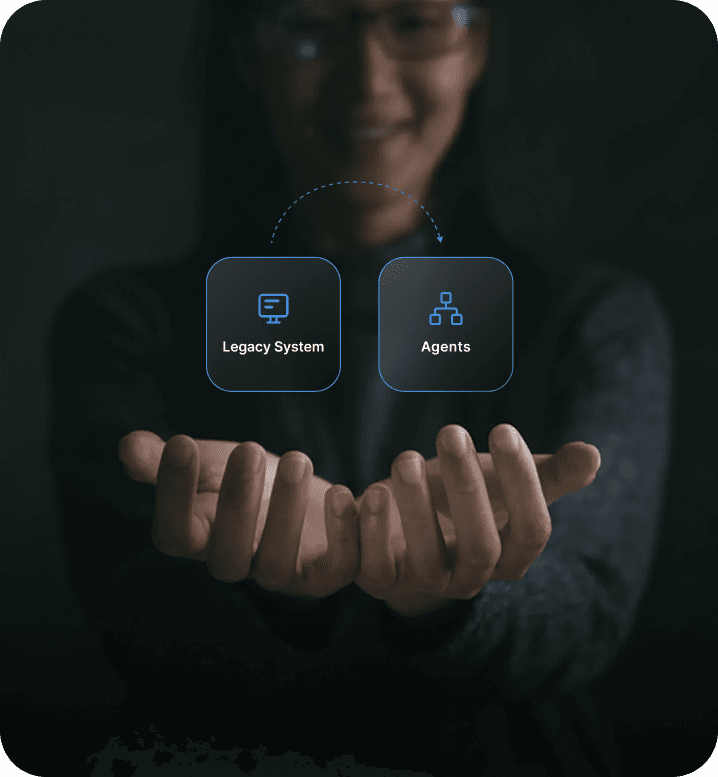
We don't modernise legacy systems by rewriting them. We modernise them by teaching agents what the systems are trying to do and letting them take over execution.
What
Legacy Modernisation Really Means
Legacy modernisation means taking an important but old system and turning it into a flexible set of smart software helpers that quietly do the same jobs, but faster, smarter and more securely, without disrupting normal operations.
Instead of replacing everything in one risky go, the existing system is gradually converted into a set of software agents that take over specific tasks like data processing, integration, monitoring, and reporting.
People continue working as usual while agents improve automation, insight, and error handling. Over time, this reduces technical debt, improves agility, and modernises technology with confidence while keeping core business processes stable and uninterrupted.
Top Problems of Having A Legacy Application
Legacy systems create compounding challenges across
your entire organization.

Cost & Effort

High maintenance cost due to constant patching, specialist skills, and extra hardware.
Low change agility, even small changes are slow, risky, and expensive.

Performance & Scalability
Poor performance under modern workloads.
Limited scalability with monolithic or on-prem designs.

Security & Compliance
Security vulnerabilities from outdated platforms.
Compliance risks with changing regulations and audit needs.

Integration & Innovation
Difficulty integrating with modern APIs, cloud, analytics, and AI.
Data silos and weak reporting.

People & Knowledge
Shrinking legacy skills pool.
Poor documentation and institutional knowledge gaps.

Process & Efficiency
High maintenance cost due to constant patching, specialist skills, and extra hardware.
Low change agility; even small changes are slow, risky, and expensive.
How it Works
We transform legacy apps into agents by decoding the code into business intent, redesigning it as modular agent workflows, and progressively deploying agents while safely retiring the legacy. We do this via 3 stages.

Code to Spec
Tame the beast
Turn messy, mysterious legacy code into clear, business-friendly stories of what the system actually does.

Spec to Design
Reimagine the playbook
Transform those stories into smart, modular agent designs that show who does what, when, and how they collaborate.

Design to Code
Ship the new cast
Build and deploy modern agents that quietly replace legacy behaviours, one slice at a time, without disrupting the business.

Code to Spec
Tame the beast
Decompile complexity into clarity
Map flows, rules, data movements, and hidden dependencies.
Explain it in plain English
“What happens when…” narratives your product, ops, and audit teams can actually use.
Create a living spec
Searchable, versioned documentation that stays aligned with the code as it evolves.
Outcome
A trusted blueprint of current behaviour—ready for modernisation, without guesswork.

Spec to Design
Reimagine the playbook
Define the cast
Agents, responsibilities, tools, and boundaries (with clear ownership, minimal overlap).
Design collaboration
Events, hand-offs, decision points, and escalation paths.
Build for governance
Observability, controls, security, and policy-by-design baked in from day one.
Outcome
An “agentic” target design that’s modular, testable, and business-aligned.

Design to Code
Ship the new cast
Slice-by-slice replacement
Introduce agents alongside the monolith, then progressively take over specific behaviours.
Prove it in production
Automated tests and monitoring to validate parity, performance, and risk.
No big-bang rewrites
Reduce outages and change fatigue while steadily modernising the estate.
Outcome
Working agents in production—measurable value now, continuous migration over time.
Comparing Benefits
Here is a phase wise approximate time and cost savings comparing manual vs our approach.
| Phase |  Manual (typical) Manual (typical) |  AI/Agent-based AI/Agent-based |  Time saving Time saving |  Cost saving Cost saving |
|---|---|---|---|---|
| Discovery & code understanding | 100% effort: manual code reading, SME interviews, documentation recreation. | GenAI agents reverse-engineer code, map dependencies, draft specs; humans review. | 30–50% | 20–40% |
| Business rules & specs extraction | Slow, SME-dependent workshops and manual document writing. | Summarisation and analyst agents generate rule catalogs and specs in natural language. | 40–60% | 30–50% |
| Target design & architecture | Manual design sessions, multiple iterations, limited what-if analysis. | AI-supported design templates; agents propose patterns, humans refine. | 20–40% | 15–30% |
| Code translation / new build | Large dev teams hand-writes or port code with high manual effort. | Code-generation and refactoring agents produce 50–70%+ of code; engineers focus on edge cases. | 40–60% | 30–50% |
| Test case creation & execution | Manual test design from specs; limited regression coverage. | AI generates tests from code and logs; agents execute and analyse test suites. | 40–60% | 30–50% |
| Cutover & migration | Big-bang releases with long freeze windows and high operational risk. | Agents wrap legacy systems, enabling phased migration and parallel runs with reduced downtime. | 30–50% | 20–40% |
| Post-go-live optimisation & support | Manual tuning, ticket handling, and periodic performance reviews. | Monitoring agents detect issues, propose fixes, and automate optimisations. | 30–50% | 20–40% |
| Overall programme (end-to-end) | Baseline: 100% of original duration and budget. | Typical 40–50% acceleration; some tasks achieve >100× speed improvements. | 40–50% | 30–40% |
Legacy  Agents Platform Story
From static code to living, goal-driven systems Transform buried logic into intelligent, autonomous operations.
The Core Problem with Legacy
Legacy technologies (COBOL, PL/I, JCL, Natural, etc.) share common constraints:

Logic is buried in code
Not expressed as intent.

Behaviour is static
Not adaptive.

Execution is batch-oriented
Not event-driven.

Change requires human intervention
Systems respond to triggers instead of anticipating.

Knowledge lives with scarce experts
Understanding is in people, not in systems.
Transformation Model
We transform legacy systems in three deliberate, non-destructive stages.

Code → Spec
Make the invisible visible
WHAT HAPPENS
- Parse legacy code
- Extract rules, flows, constraints
- Produce machine-readable specs (policies, workflows, decision graphs)
Agent Value
Agents now understand what the system does, not just how it runs.

Spec → Design
Reimagine behaviour, not code
WHAT HAPPENS
- Specs become agent blueprints
- Business intent is separated from execution
- Responsibilities are modularised
Agent Types Introduced
Decision agents, Routing agents, Compliance agents, Scheduling agents

Design → Code
Create an agent-ready foundation
WHAT HAPPENS
- Legacy logic runs as APIs & events
- Kubernetes becomes the execution fabric
- Services expose intent + telemetry
Agent Value
Agents can now observe, reason, and act.

Legacy → Agents
Legacy systems become agent-supervised assets, not liabilities.
Agents Take Over
- Agents take over decision making
- Exception handling becomes autonomous
- Optimisation runs continuously
- Self-healing infrastructure
Code Intelligence
Parse, Map, Explain
Business Specs
Rules, Policies, Flows
Agent Designs
Goals, Capabilities, Constraints
Cloud Runtime
APIs, Events, Workflows
Autonomous Agents
Decision, Ops, Optimisation
Why This Works

Agents introduced incrementally

No big-bang rewrite

Legacy systems continue to run

Business meaning preserved

Human expertise becomes encoded
This is evolution, not replacement.
What This Unlocks

Faster change without touching core code

Reduced dependency on legacy skills

Continuous optimisation

Agentic AI layered above legacy, not buried inside it
Tech View modernisation Roadmap
Here is a typical roadmap of Legacy to Agents include Cloud Journeys. We are not doing a like-for-like rewrite. We progressively extract business logic from legacy languages into modern, cloud-native services, enabling automation, resilience, and AI augmentation.

Core Programming Languages → Modern Equivalents
| Legacy Technology | Typical Modern Replacement | Notes / Migration Approach |
|---|---|---|
| COBOL | Java, C#, Kotlin, Spring Boot | Re-platform core logic as domain services; often strangled rather than rewritten |
| Assembly (HLASM) | C/C++, Rust | Only migrate where unavoidable; often isolate behind APIs |
| PL/I | Java, C#, Python | Logic extraction + service refactoring |
| FORTRAN | Python (NumPy), C++, Julia | Common in analytics and scientific workloads |
| RPG (IBM i) | Java, .NET, Node.js | Often paired with database modernisation |
| REXX | Python, Bash, PowerShell | Straightforward script migration |

4GL / Proprietary Languages → Modern Equivalents
| Legacy Technology | Modern Target | Notes |
|---|---|---|
| SAG Natural | Java + REST APIs | Often part of Adabas → relational migration |
| CA-Ideal | Java, .NET | Logic extracted into microservices |
| Cincom Mantis | Low-code (Power Platform), Java | UI + business logic separation |
| Mark IV | SQL, BI tools (Power BI, Tableau) | Reporting modernisation |
| APL | Python, R | Mathematical logic translation |

Specialized / Obsolete Languages → Modern Equivalents
| Legacy Technology | Modern Target | Notes |
|---|---|---|
| JOVIAL | C++, Ada | Defence/aerospace modernisation |
| SNOBOL | Python, Perl | Text processing rewrite |
| ALGOL | Java, C++ | Conceptual rewrite required |
| BASIC | JavaScript, Python | Typically UI or batch rewrite |

Mainframe Control & Support → Cloud-Native Equivalents
| Legacy Technology | Typical Modern Replacement | Notes / Migration Approach |
|---|---|---|
| JCL | CI/CD pipelines, Workflow engines | GitHub Actions, Azure DevOps, Argo |
| CLIST | Python, Bash | Script migration |

Batch & Scheduling
| Legacy Pattern | Modern Equivalent |
|---|---|
| Mainframe batch jobs | Event-driven workflows |
| Nightly batch windows | Streaming / near-real-time |
| File-based integration | APIs / messaging |
Modern Target Architecture
Languages
Java, C#, Python, JavaScript
Runtime
Containers, Kubernetes (AKS / EKS)
Integration
APIs, events, message brokers
Orchestration
GitOps, workflow engines
Automation
CI/CD, Infrastructure as Code
Proof of Concept Plan
Here is a concise 6‑week proof‑of‑concept plan.

Enablement & Scoping

Activities
Environment access (VPN, SSO, repos, ticketing), data and security checks, stakeholder workshops to shortlist 1–2 candidate processes/screens for the PoC.

Outcomes
PoC charter, success criteria, RACI, agreed legacy scope (codebase, interfaces, test data), and non‑functional constraints (security, privacy, performance).

Code to Spec
Activities
Run our accelerator over the selected legacy code to extract structure, flows, and business rules; validate findings with SMEs through short read‑out sessions.
Outcomes
Reviewed “as‑is” functional spec, rule catalog, and dependency map for the chosen slice; list of clarifications and tech debt hotspots.

Spec to Design
Activities
Translate the validated spec into an agentic architecture for the PoC (agent roles, inputs/outputs, contracts, observability); hold design reviews with architecture and security.
Outcomes
Target blueprint for the PoC slice, including agent interaction diagram, data flows, security controls, and alignment notes against enterprise standards.

Design to Agents
Activities
Implement the first set of agents and supporting services; create automated tests from the spec and known edge cases; run iterative test–fix cycles.
Outcomes
Working agent implementations for the PoC scope, passing regression and edge‑case tests, with basic monitoring and logging enabled.

Deploy & Parallel Run
Activities
Deploy agents into a lower or pre‑prod environment; connect to legacy interfaces; run a controlled parallel run using historical and live transactions.
Outcomes
Side‑by‑side comparison of agent vs legacy behaviour (accuracy, latency, failure modes), plus a run report highlighting discrepancies and improvements.

Learnings & Business Case
Activities
Capture technical, operational, and stakeholder feedback; quantify time and effort saved in discovery, design, build, and testing; document risks and mitigations.
Outcomes
PoC report and demo, quantified benefits (cycle‑time and effort reduction for the slice), roadmap options, and a business case for scaling modernisation with agents.
Technology Partners


Ready to transform your legacy?
Start with a single system. See results in weeks, not years.